
Results

At G Ratings, we conducted a statewide public opinion survey to measure electoral preferences and the political climate ahead of the 2026 Florida Governor Primary Election.
We surveyed adults aged 18 and older residing in Florida who confirmed that they were registered to vote and intended to participate in the upcoming election.
In this study, we present the latest findings on political affiliation, Democratic and Republican primary preferences, the main issues facing Florida, and the demographic profile of respondents.
The results show Byron Donalds leading the Republican primary with 45.3%, while David Jolly leads the Democratic primary field with 25.3%.
Political Affiliation of Respondents
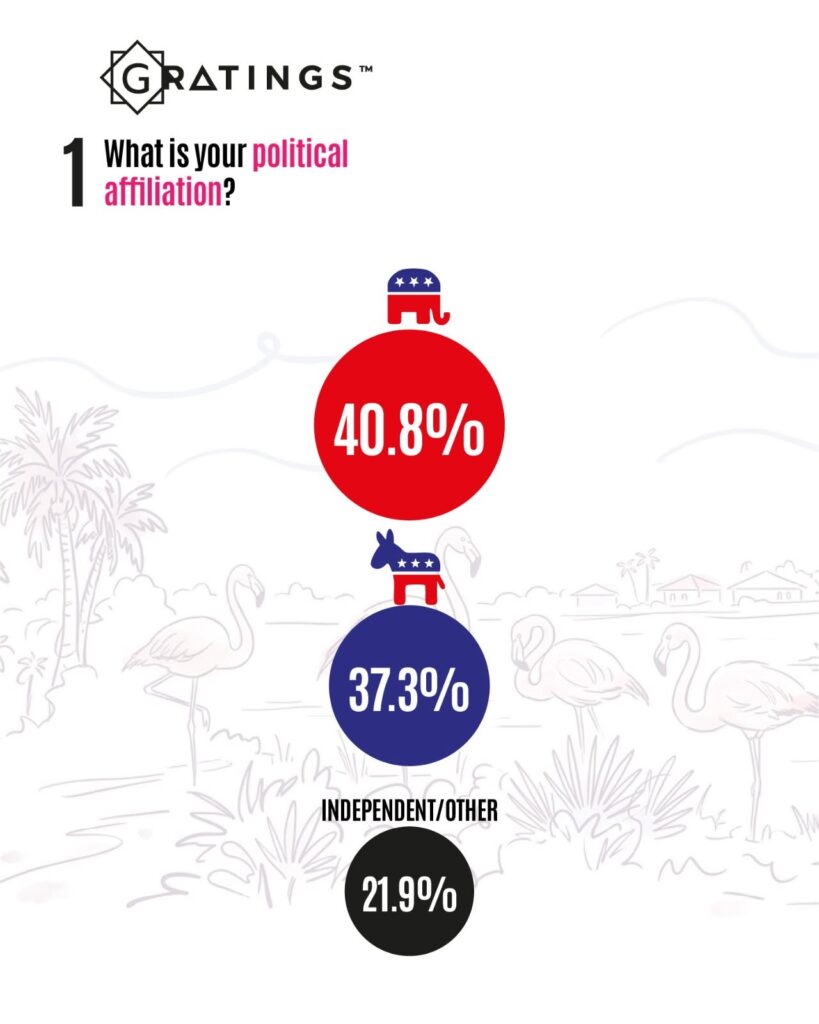
At G Ratings, we measured the political affiliation of survey participants. The results show a competitive political environment, with Republican respondents ahead of Democratic respondents and a significant independent or other segment.
- Republican affiliation: 40.8%
- Democratic affiliation: 37.3%
- Independent or other affiliation: 21.9%
This distribution provides context for understanding voter preferences and the broader political environment in Florida ahead of the 2026 gubernatorial election.
Democratic Primary for Governor
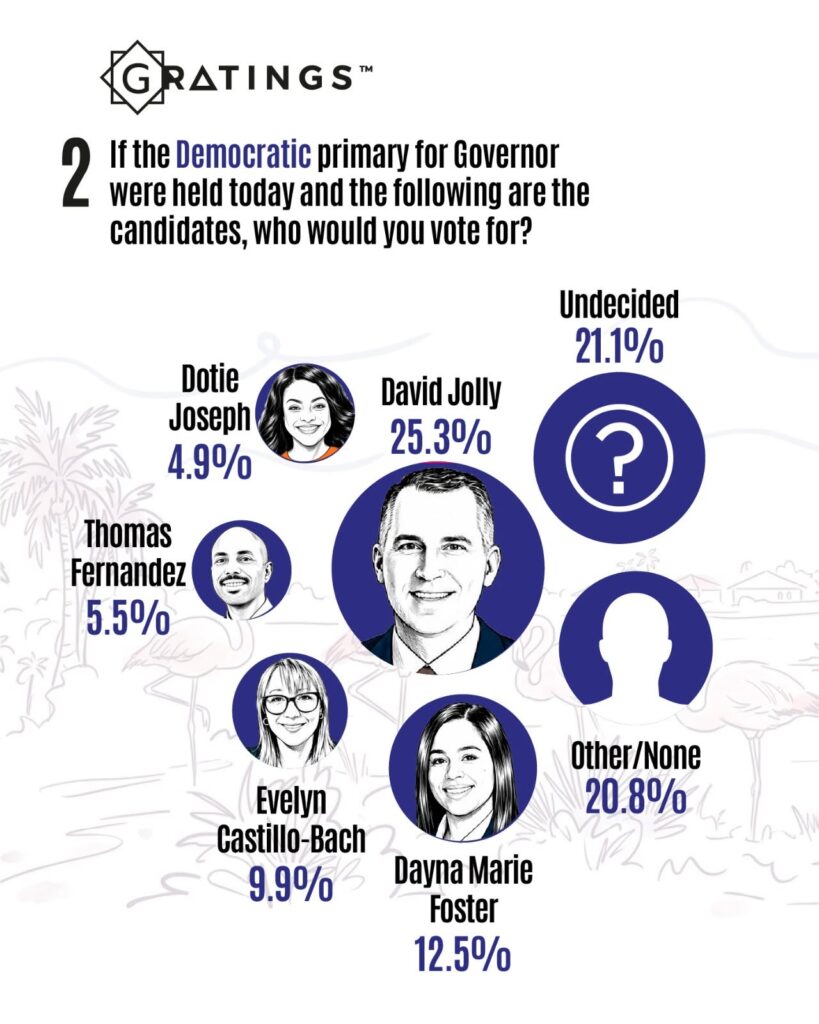
If the Democratic primary for Governor of Florida were held today, respondents expressed the following voting preferences:
- David Jolly: 25.3%
- Undecided: 21.1%
- Other or None: 20.8%
- Dayna Marie Foster: 12.5%
- Evelyn Castillo-Bach: 9.9%
- Thomas Fernandez: 5.5%
- Dotie Joseph: 4.9%
The results show David Jolly leading among the listed Democratic candidates. However, the combined share of undecided voters and those selecting Other or None suggests that the Democratic primary remains open and fluid.
Republican Primary for Governor
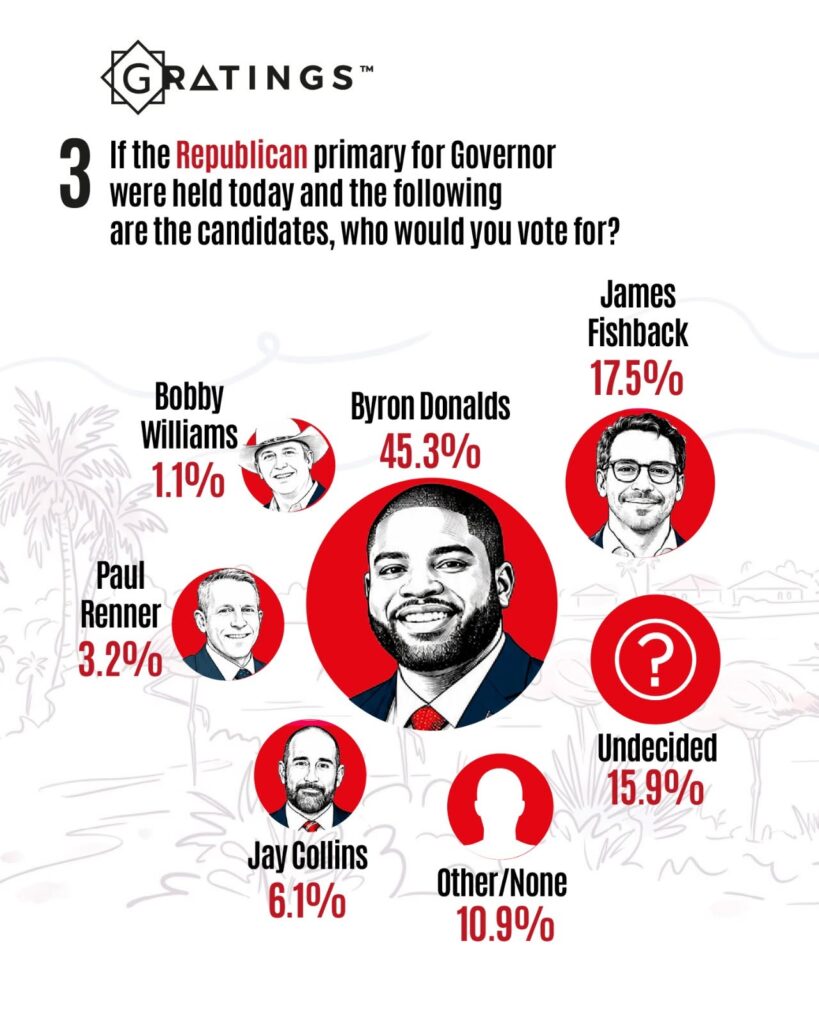
In the Republican primary, Byron Donalds holds a clear lead over the rest of the field.
- Byron Donalds: 45.3%
- James Fishback: 17.5%
- Undecided: 15.9%
- Other or None: 10.9%
- Jay Collins: 6.1%
- Paul Renner: 3.2%
- Bobby Williams: 1.1%
Byron Donalds begins the race with a strong advantage among Republican primary voters, while James Fishback appears as the closest listed challenger. Undecided voters remain an important factor as the campaign develops.
Main Issues Facing Florida
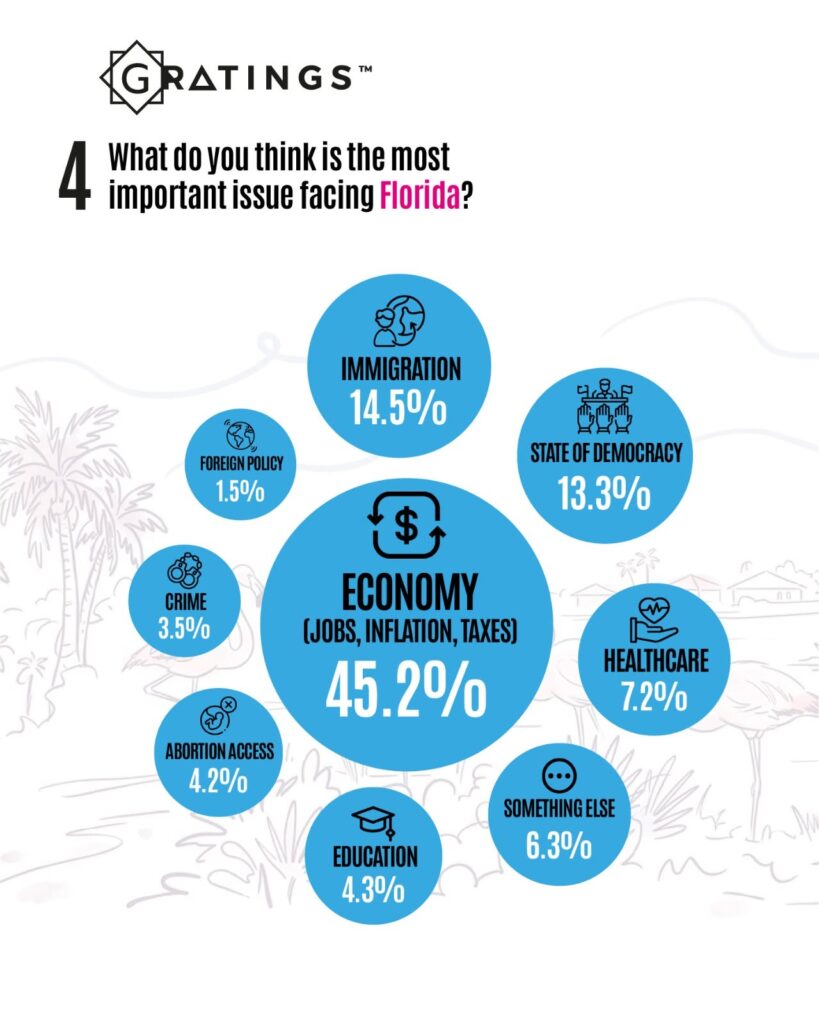
We surveyed respondents about what they consider the most important issue facing Florida today. The results show that the economy is the leading concern by a wide margin.
- Economy, jobs, inflation, and taxes: 45.2%
- Immigration: 14.5%
- State of democracy: 13.3%
- Healthcare: 7.2%
- Something else: 6.3%
- Education: 4.3%
- Abortion access: 4.2%
- Crime: 3.5%
- Foreign policy: 1.5%
The findings suggest that economic pressure, immigration, and concerns over the state of democracy are shaping voter priorities as Florida moves closer to the 2026 gubernatorial election.
Demographic Profile of the Survey
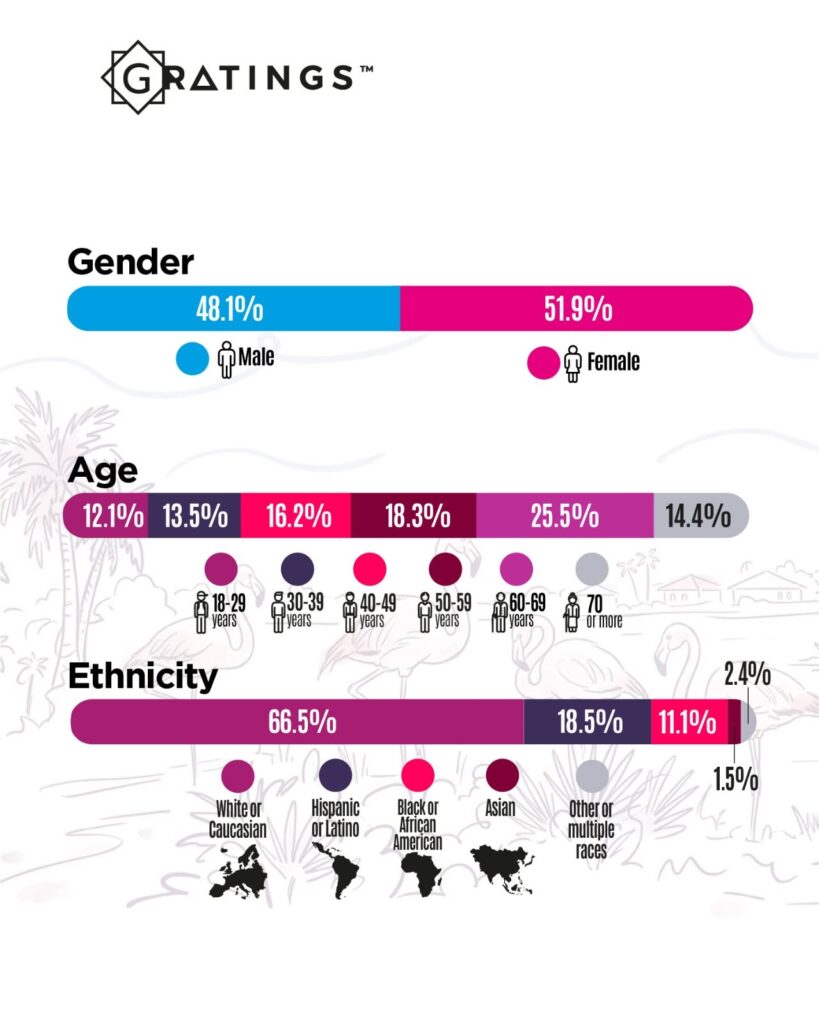
The survey included a demographic profile across gender, age, and ethnicity.
By gender, respondents were distributed as follows:
- Female: 51.9%
- Male: 48.1%
By age group, respondents were distributed as follows:
- 18–29 years: 12.1%
- 30–39 years: 13.5%
- 40–49 years: 16.2%
- 50–59 years: 18.3%
- 60–69 years: 25.5%
- 70 years or older: 14.4%
By ethnicity, the survey recorded the following composition:
- White or Caucasian: 66.5%
- Hispanic or Latino: 18.5%
- Black or African American: 11.1%
- Other or multiple races: 2.4%
- Asian: 1.5%
Methodology
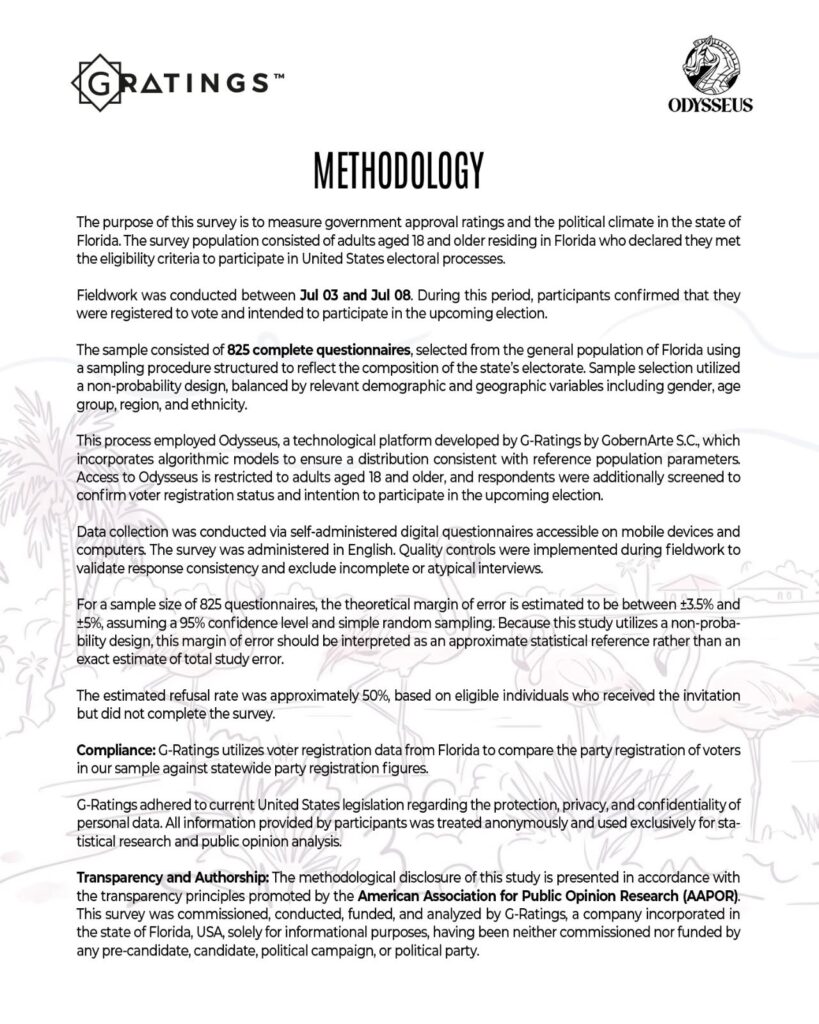
At G Ratings, we conducted this survey among 825 complete questionnaires from adults aged 18 and older residing in Florida.
Fieldwork was conducted between July 03 and July 08. During this period, participants confirmed that they were registered to vote and intended to participate in the upcoming election.
The study used a non-probability sample design, balanced by relevant demographic and geographic variables, including gender, age group, region, and ethnicity.
This process employed Odysseus, a technological platform developed by G Ratings by GobernArte S.C., incorporating algorithmic models designed to ensure a distribution consistent with reference population parameters.
Data collection was conducted through self-administered digital questionnaires accessible on mobile devices and computers. The survey was administered in English.
For a sample size of 825 questionnaires, the theoretical margin of error is estimated between ±3.5% and ±5%, assuming a 95% confidence level and simple random sampling. Because this study uses a non-probability design, the margin of error should be interpreted as an approximate statistical reference rather than an exact estimate of total study error.
The estimated refusal rate was approximately 50%, based on eligible individuals who received the invitation but did not complete the survey.
G Ratings adhered to current United States legislation regarding the protection, privacy, and confidentiality of personal data. All information provided by participants was treated anonymously and used exclusively for statistical research and public opinion analysis.
This survey was commissioned, conducted, funded, and analyzed by G Ratings, a company incorporated in the state of Florida, USA, solely for informational purposes and was neither commissioned nor funded by any pre-candidate, candidate, political campaign, or political party.