
Results


At G Ratings, we conducted a statewide survey in Ohio to measure electoral preferences and the political climate ahead of the 2026 elections. The results show highly competitive contests for governor and the U.S. Senate, with relatively narrow differences separating the leading candidates.
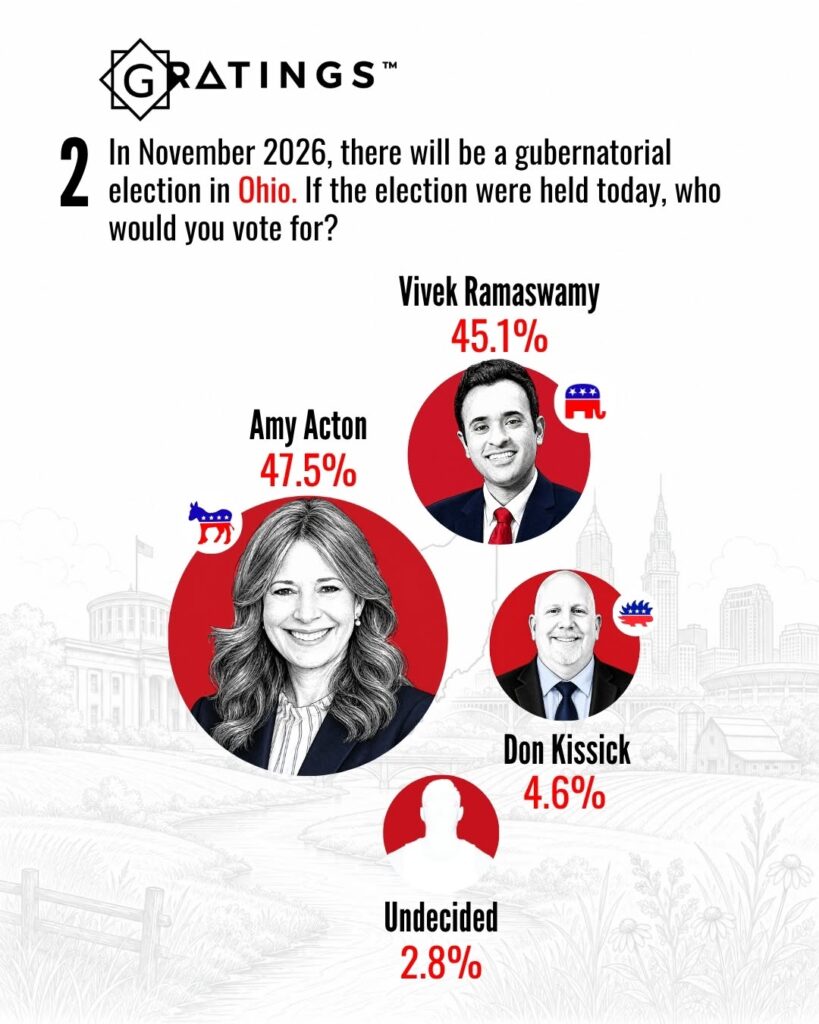
In the race for governor, Democrat Amy Acton leads with 47.5%, followed closely by Republican Vivek Ramaswamy at 45.1%. Don Kissick receives 4.6%, while 2.8% of respondents remain undecided.
Amy Acton holds a narrow lead in the Ohio governor race
At G Ratings, we surveyed Ohio voters about how they would vote if the November 2026 gubernatorial election were held today.
The results show a race separated by only 2.4 percentage points between Acton and Ramaswamy, indicating a highly competitive electoral environment.
- Amy Acton: 47.5%
- Vivek Ramaswamy: 45.1%
- Don Kissick: 4.6%
- Undecided: 2.8%
Neither of the two leading candidates reaches 50%, while the relatively small undecided segment could become important as the campaign progresses.
Sherrod Brown leads Ohio’s 2026 U.S. Senate special election
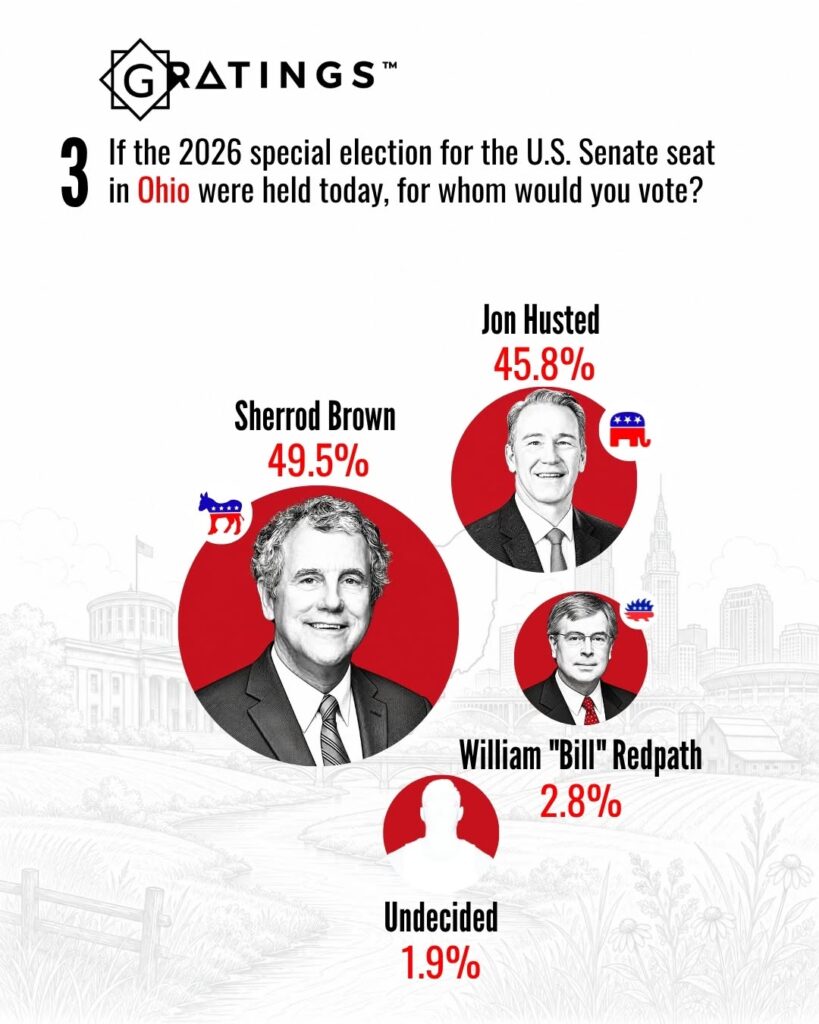
The G Ratings survey also measured voter preferences in the 2026 special election for Ohio’s U.S. Senate seat.
Former Senator Sherrod Brown leads with 49.5%, while Republican Jon Husted receives 45.8%. William “Bill” Redpath registers 2.8%, and 1.9% of respondents remain undecided.
- Sherrod Brown: 49.5%
- Jon Husted: 45.8%
- William “Bill” Redpath: 2.8%
- Undecided: 1.9%
Brown’s advantage over Husted stands at 3.7 percentage points, placing the Senate contest among the closely watched statewide races heading toward the 2026 election.
Democrats represent the largest political affiliation group
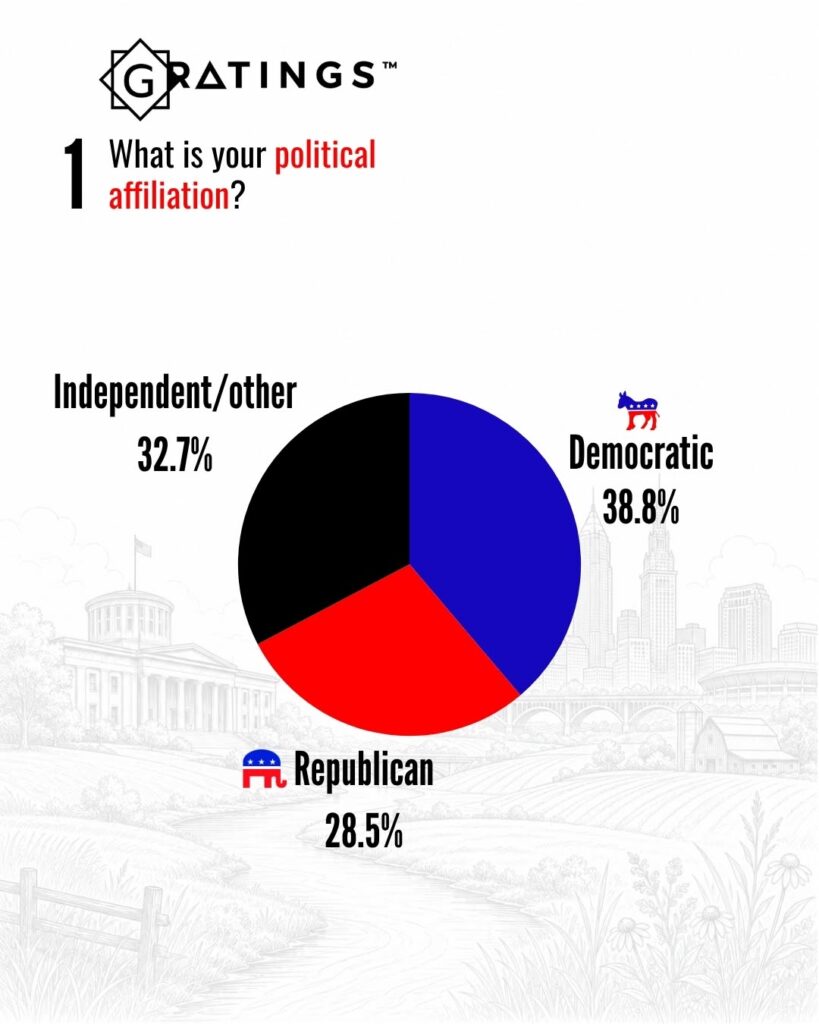
At G Ratings, we also surveyed respondents about their political affiliation. Democrats represent the largest group in the sample, followed by independents and other voters.
- Democratic: 38.8%
- Independent/Other: 32.7%
- Republican: 28.5%
The figures highlight the importance of voters who identify as independent or with another political affiliation. This group represents nearly one-third of respondents and could play an important role in both statewide contests.
Economy is the top issue facing Ohio
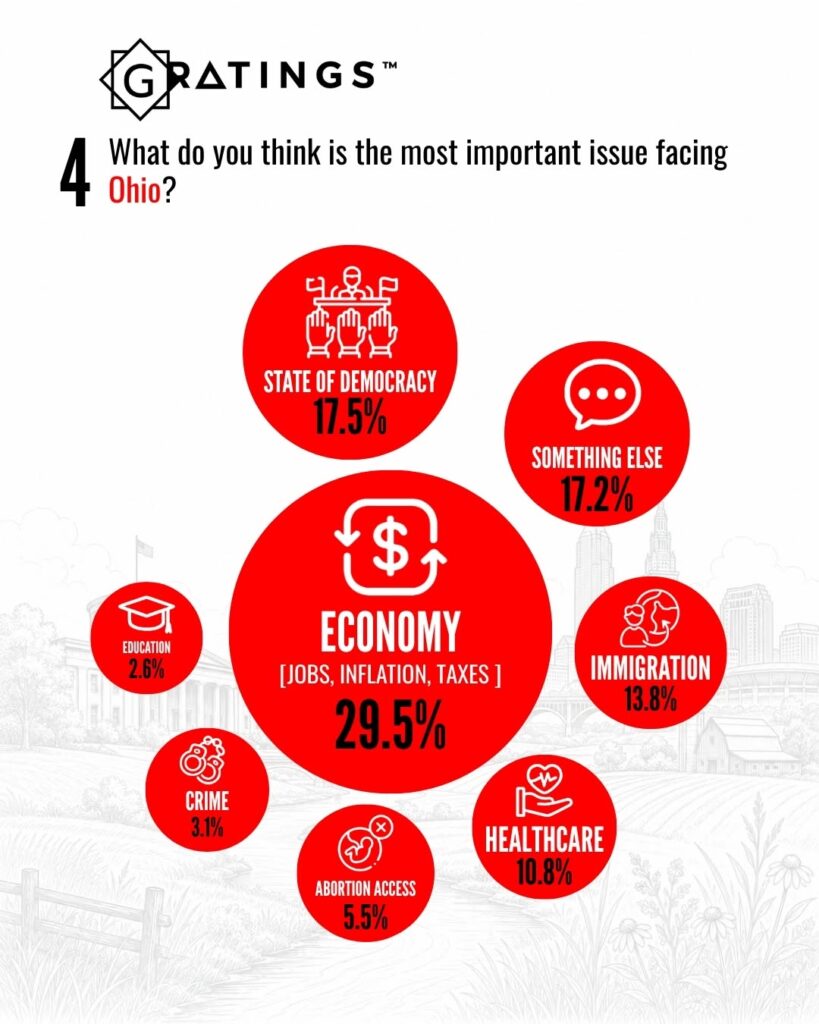
Beyond candidate preference, we present the issues Ohio voters consider most important. The economy, including jobs, inflation and taxes, ranks clearly ahead of the other options measured.
- Economy — jobs, inflation and taxes: 29.5%
- State of democracy: 17.5%
- Something else: 17.2%
- Immigration: 13.8%
- Healthcare: 10.8%
- Abortion access: 5.5%
- Crime: 3.1%
- Education: 2.6%
Nearly three in ten respondents identify the economy as Ohio’s most important issue, giving economic concerns a considerable advantage over every other category measured.
The state of democracy ranks second at 17.5%, followed closely by other concerns at 17.2%. Immigration and healthcare also remain significant issues among Ohio voters.
Ohio voters reflect different demographic groups
The survey included voters across multiple age groups and demographic profiles.
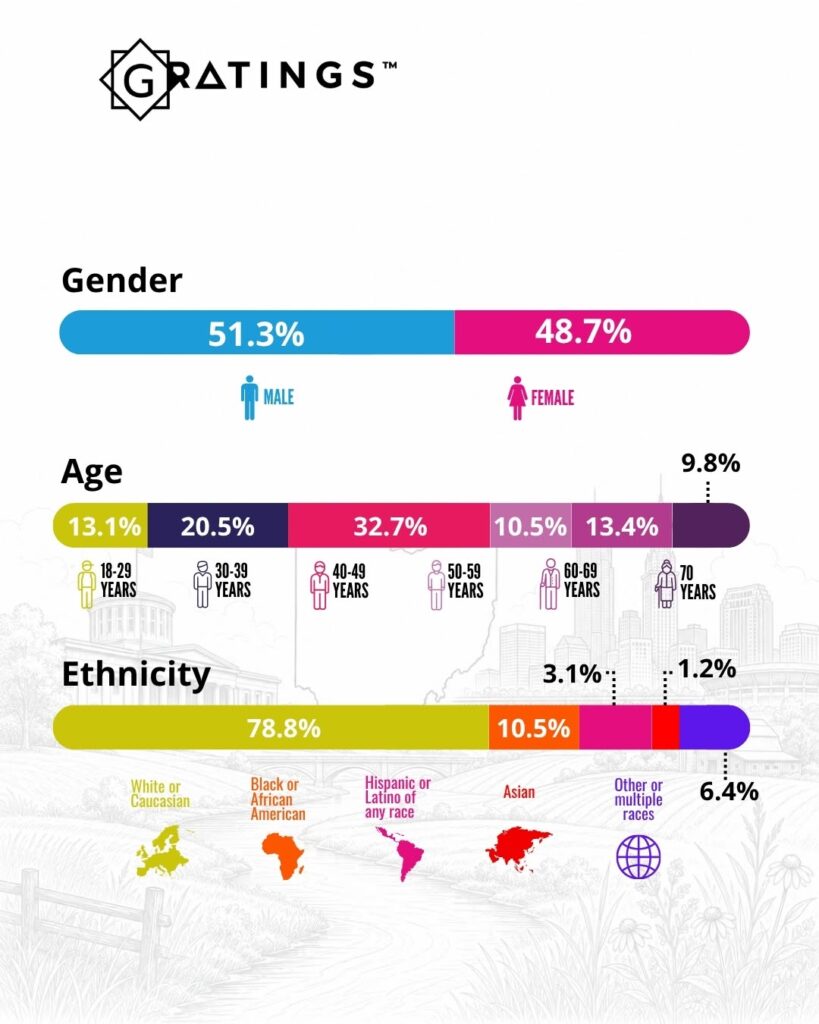
Men represented 51.3% of respondents, while women accounted for 48.7%.
By age, respondents were distributed as follows:
- 18–29 years old: 13.1%
- 30–39 years old: 20.5%
- 40–49 years old: 32.7%
- 50–59 years old: 10.5%
- 60–69 years old: 13.4%
- 70 years and older: 9.8%
The largest age group in the survey was voters between 40 and 49 years old, representing 32.7% of respondents.
By ethnicity, 78.8% identified as White or Caucasian, 10.5% as Black or African American, 3.1% as Hispanic or Latino of any race, 1.2% as Asian and 6.4% as other or multiple races.
G Ratings surveyed 900 Ohio voters
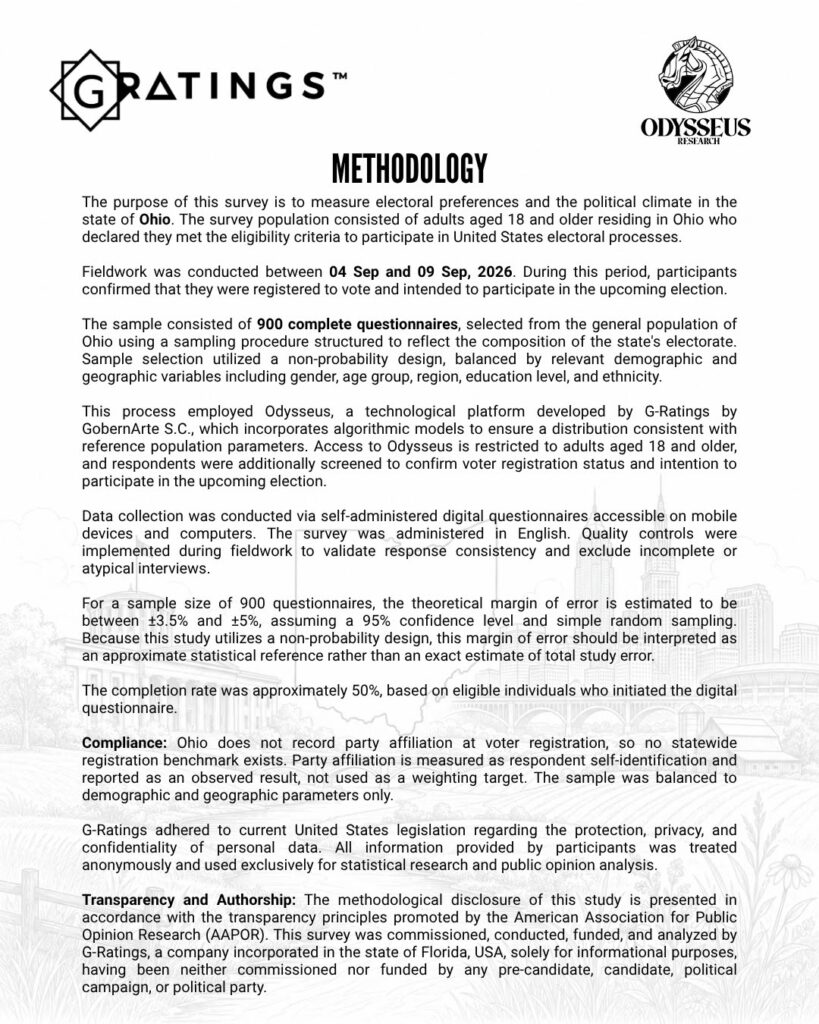
At G Ratings, we surveyed 900 adults aged 18 and older residing in Ohio who met the eligibility requirements to participate in United States electoral processes.
Fieldwork was conducted from September 4 through September 9, 2026. Participants confirmed that they were registered to vote and intended to participate in the upcoming election.
The study used 900 completed questionnaires and a non-probability sampling design balanced according to demographic and geographic variables, including gender, age group, region, education level and ethnicity.
The survey used Odysseus, the technological platform employed by G Ratings to administer questionnaires and screen respondents according to voter registration and electoral participation criteria.
For the sample of 900 questionnaires, the study reports a theoretical margin of error between ±3.5% and ±5% at a 95% confidence level. Because the study uses a non-probability design, this range should be interpreted as an approximate statistical reference rather than an exact estimate of total study error.
Ohio enters 2026 with two competitive statewide elections
At G Ratings, we present this September measurement as a snapshot of voter preferences at the time of fieldwork.
The results show Amy Acton holding a narrow lead over Vivek Ramaswamy in the race for governor, while Sherrod Brown leads Jon Husted in the special election for U.S. Senate.
At the same time, economic concerns remain the dominant issue among Ohio voters, suggesting that jobs, inflation and taxes could have a significant role in shaping voter decisions as the 2026 campaigns develop.