
Results


At G Ratings, we conducted a statewide survey in North Carolina to measure voter preferences ahead of the 2026 U.S. Senate general election. The results show Democrat Roy Cooper holding a significant advantage over Republican Michael Whatley in the current electoral scenario.
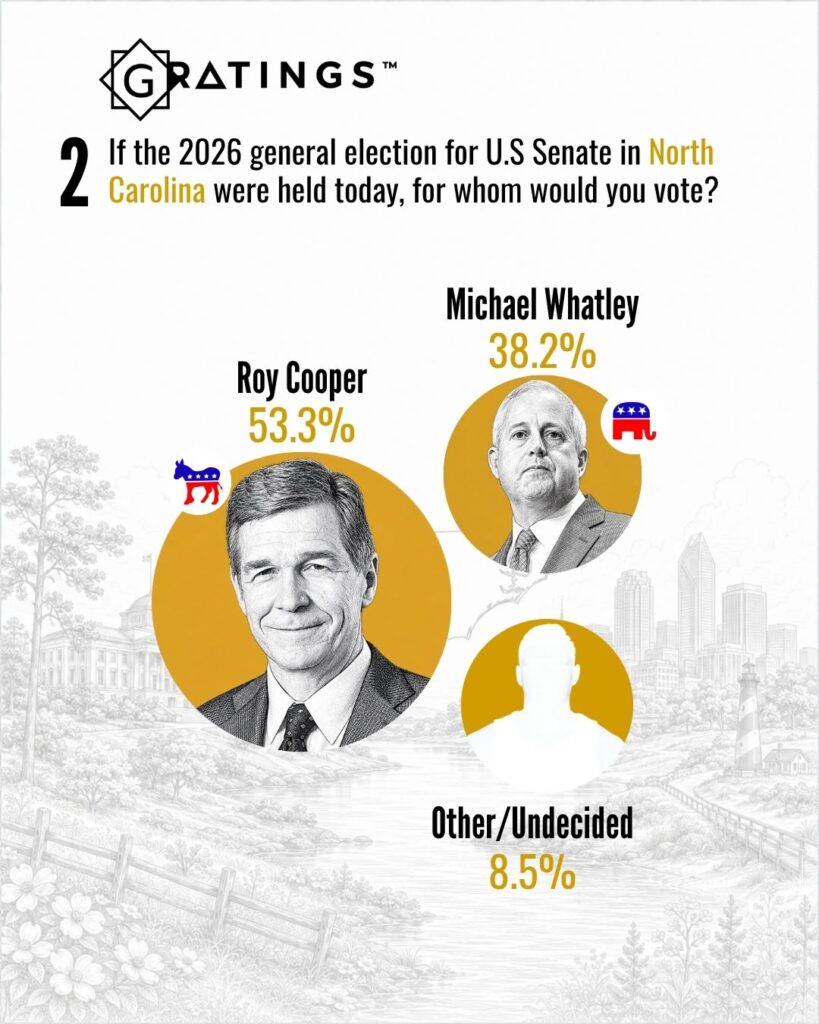
We surveyed registered voters across North Carolina and asked how they would vote if the 2026 U.S. Senate general election were held today. Cooper receives 53.3% of voter support, while Whatley stands at 38.2%. Another 8.5% selected another option or remain undecided.
The results place Cooper 15.1 percentage points ahead of Whatley, establishing a clear lead at the time of the survey. However, the undecided and other-voter segment remains relevant as the campaign moves closer to Election Day.
Roy Cooper leads the 2026 North Carolina Senate race
At G Ratings, we present the current voting preferences measured among North Carolina voters:
- Roy Cooper, Democratic: 53.3%
- Michael Whatley, Republican: 38.2%
- Other/Undecided: 8.5%
The findings indicate that Cooper currently attracts support from more than half of surveyed voters, while Whatley would need to close a double-digit gap to make the contest more competitive.
The 8.5% of voters who remain undecided or prefer another option could still influence the final composition of the race, particularly as both campaigns increase voter outreach and messaging.
Democrats hold a slight advantage in political affiliation
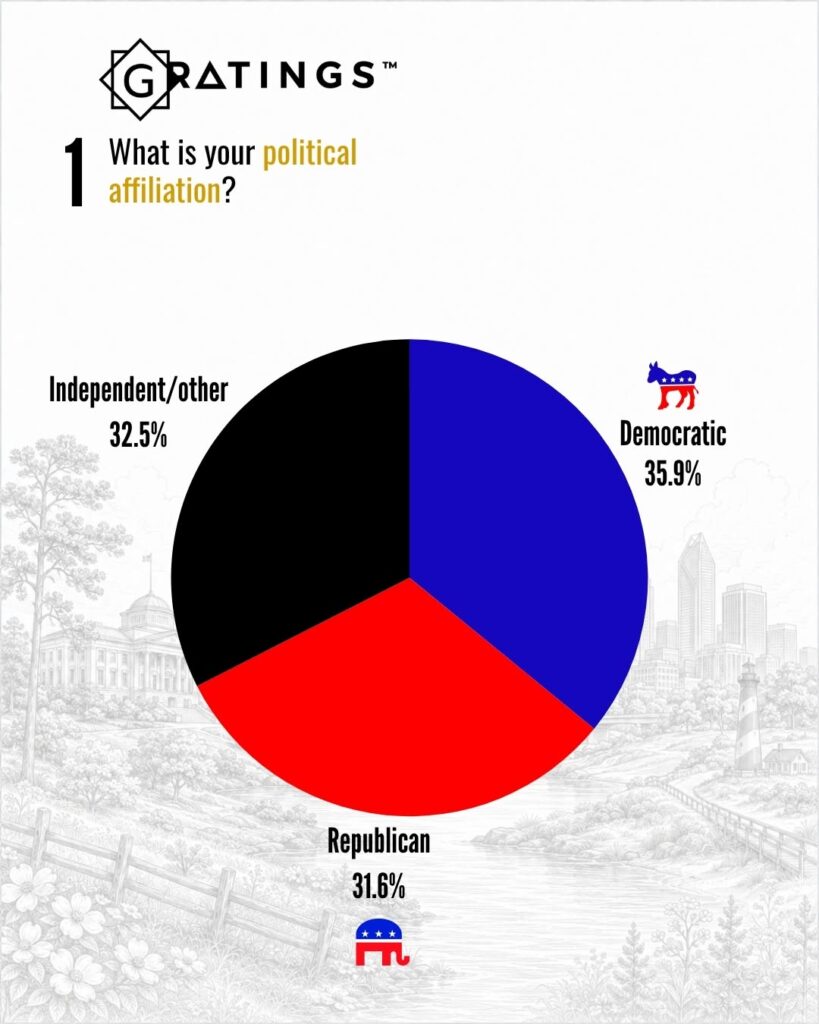
We also surveyed respondents about their political affiliation. The results show a relatively balanced electorate, with Democrats holding the largest individual share.
- Democratic: 35.9%
- Independent/Other: 32.5%
- Republican: 31.6%
The data show that no political affiliation accounts for an absolute majority of respondents. Independent and other voters represent nearly one-third of the electorate, making this segment particularly important for the Senate contest.
Economy is the top issue for North Carolina voters
Beyond candidate preference, G Ratings asked voters to identify the most important issue currently facing North Carolina.
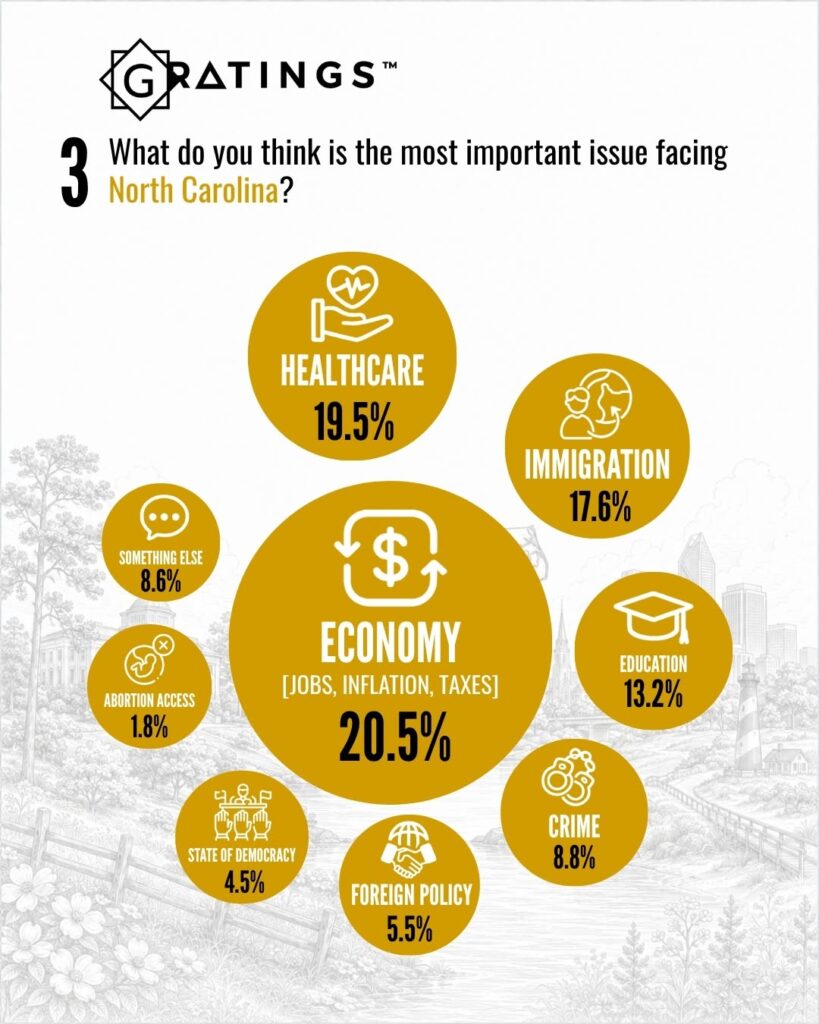
The economy ranks first, although several other issues also register significant concern among respondents.
- Economy — jobs, inflation and taxes: 20.5%
- Healthcare: 19.5%
- Immigration: 17.6%
- Education: 13.2%
- Crime: 8.8%
- Something else: 8.6%
- Foreign policy: 5.5%
- State of democracy: 4.5%
- Abortion access: 1.8%
The results show that economic concerns, healthcare and immigration together account for the largest share of voter priorities.
The economy ranks first at 20.5%, but only one percentage point separates it from healthcare. Immigration follows closely at 17.6%, showing that North Carolina voters are focused on a combination of economic, domestic and social policy issues.
A diverse electorate across age and demographic groups
The G Ratings survey also measured the demographic composition of respondents.
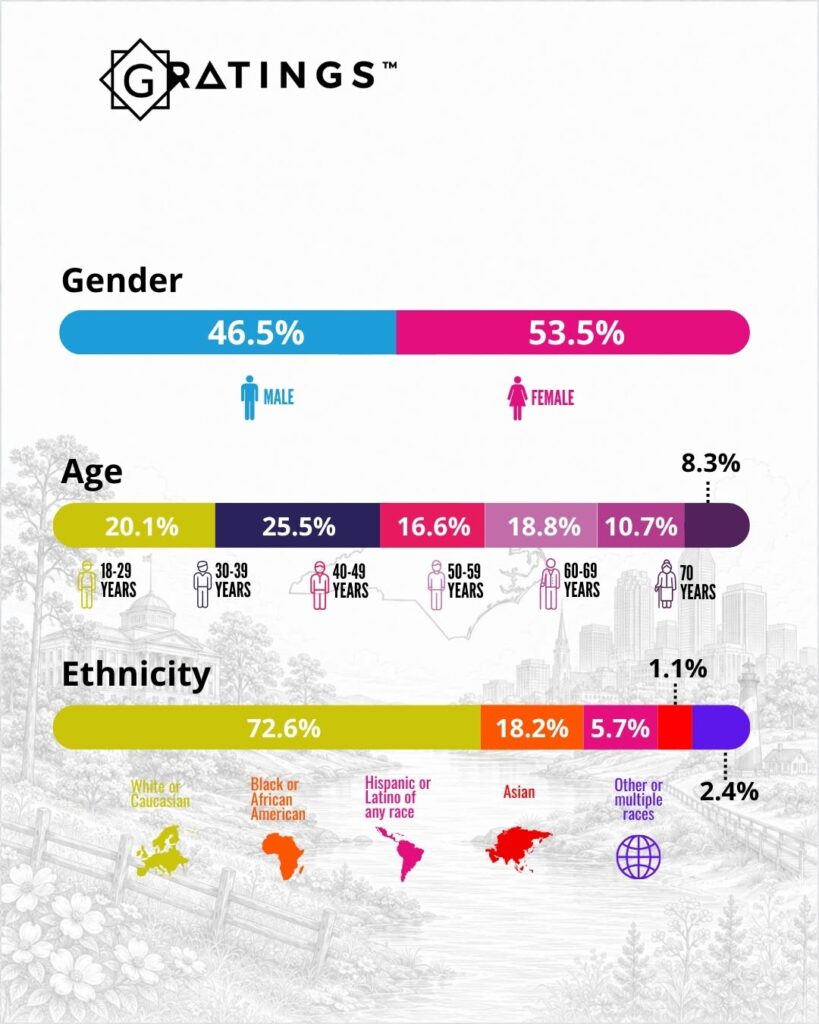
Women represented 53.5% of participants, while men accounted for 46.5%.
By age, the survey included voters from across the adult population:
- 18–29 years old: 20.1%
- 30–39 years old: 25.5%
- 40–49 years old: 16.6%
- 50–59 years old: 18.8%
- 60–69 years old: 10.7%
- 70 years and older: 8.3%
The largest age group was voters between 30 and 39 years old, representing 25.5% of respondents.
By ethnicity, 72.6% identified as White or Caucasian, 18.2% as Black or African American, 5.7% as Hispanic or Latino of any race, 1.1% as Asian and 2.4% as other or multiple races.
G Ratings surveyed 750 North Carolina voters
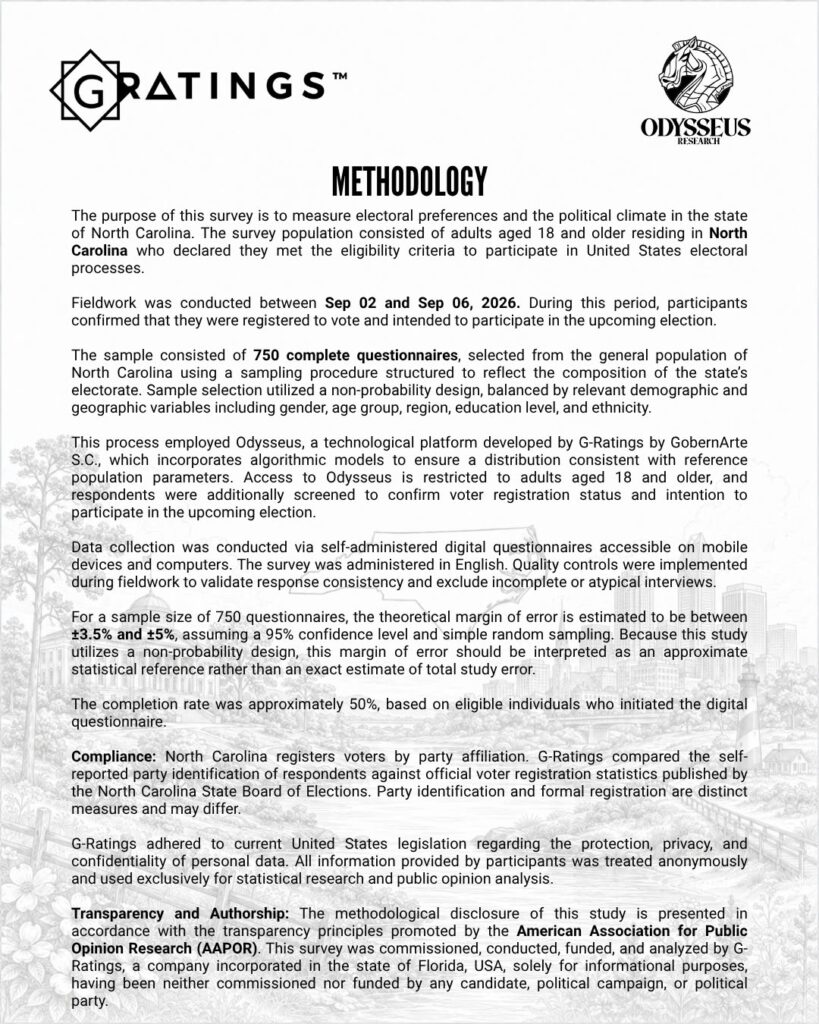
At G Ratings, we surveyed 750 adults aged 18 and older who live in North Carolina, were registered to vote and indicated their intention to participate in the upcoming election.
Fieldwork was conducted from September 2 through September 6, 2026. The questionnaires were self-administered digitally and could be completed using mobile devices or computers.
The study used a non-probability sampling design, balanced according to relevant demographic and geographic characteristics of North Carolina’s electorate.
The survey was administered through Odysseus, the technological platform used by G Ratings for data collection and respondent screening.
For a sample of 750 questionnaires, the study reports a theoretical margin of error of approximately ±3.5% at a 95% confidence level, while noting that this figure should be interpreted as a statistical reference because the survey uses a non-probability design.
North Carolina Senate race enters a key stage
The September measurement shows Roy Cooper with a clear advantage in the 2026 U.S. Senate race, while Michael Whatley remains below the 40% threshold in current voter preference.
At the same time, the survey identifies an electorate concerned primarily with the economy, healthcare and immigration, issues that could shape campaign messaging and voter decisions in the months ahead.
At G Ratings, we present these results as a measurement of voter sentiment during the fieldwork period, providing a snapshot of electoral preferences and the political climate in North Carolina as the 2026 election approaches.