
Results
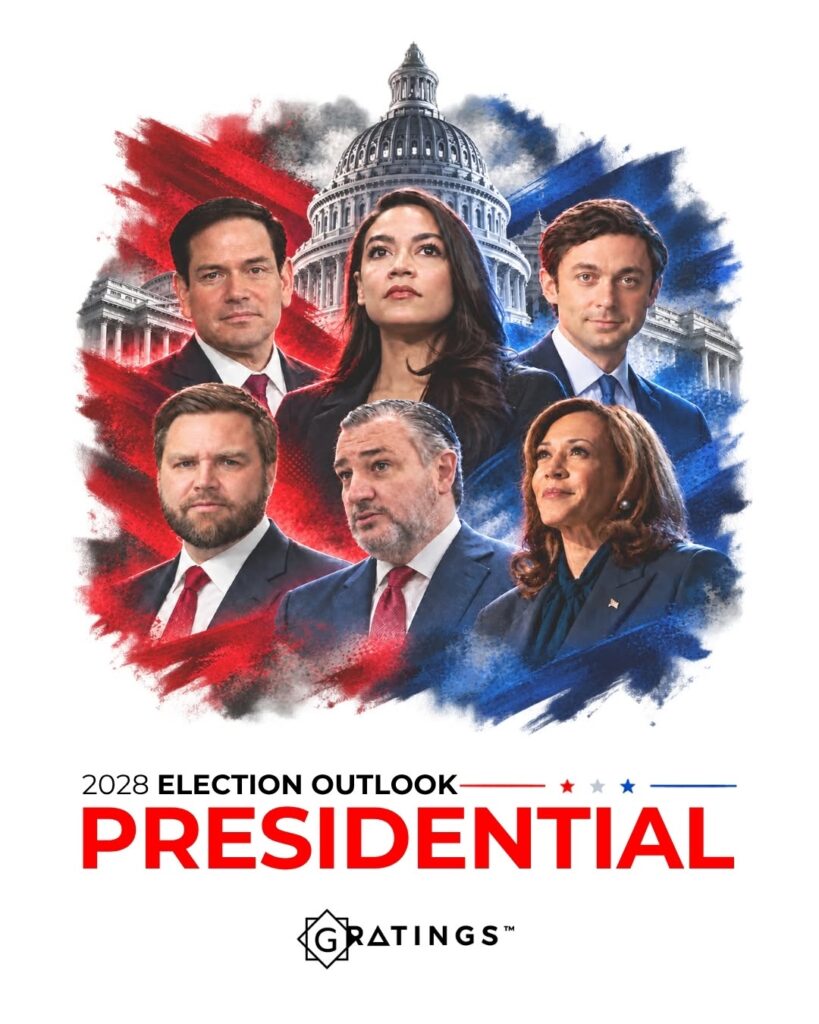

At G Ratings, we conducted a nationwide survey to measure voter preferences ahead of the 2028 Democratic and Republican presidential primary elections in the United States.
The results place Marco Rubio at the top of the Republican field with 28.6%, closely followed by J.D. Vance with 25.7%. Among Democrats, Alexandria Ocasio-Cortez leads with 23.3%, while Jon Ossoff and Kamala Harris occupy the next two positions.
We surveyed 1,000 registered voters who identified as either Democrats or Republicans. The fieldwork was conducted from October 1 through October 5, 2026, using self-administered digital questionnaires.
In this report, we present party affiliation, presidential preferences and the issues respondents consider most important for the United States.
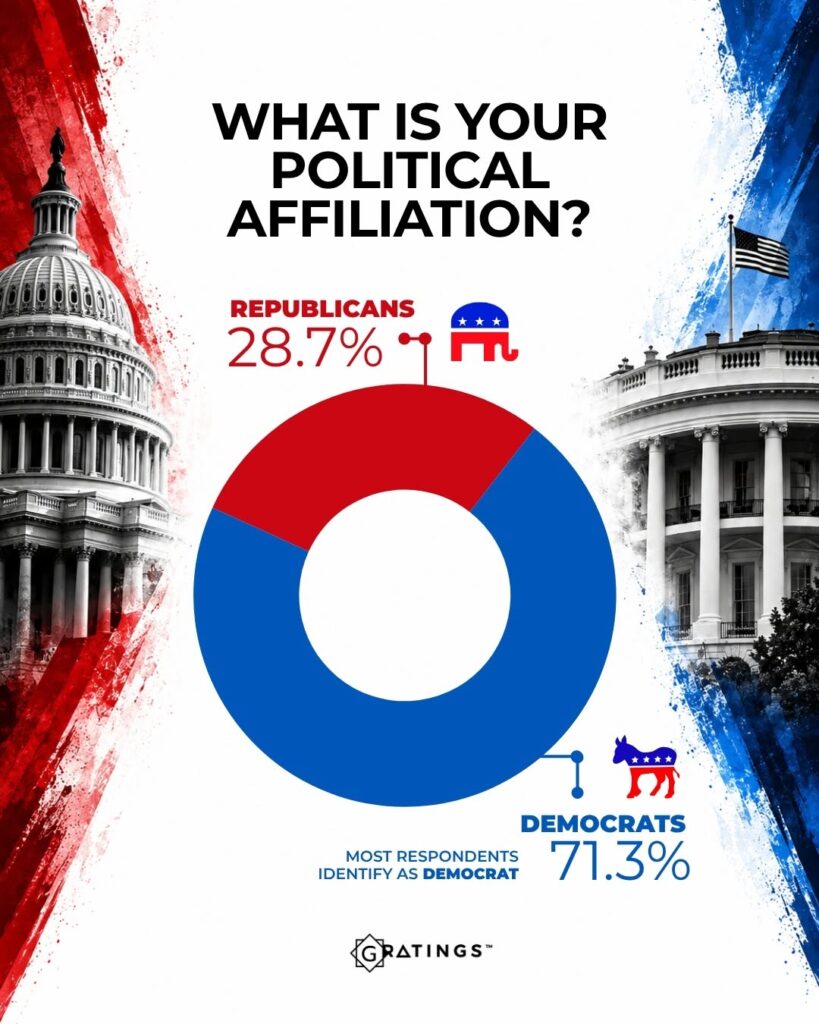
Democrats represent the largest group in the survey
The party affiliation results show that Democratic voters made up the majority of the sample.
- Democrats: 71.3%
- Republicans: 28.7%
The survey population included voters who identified with one of the two major political parties. Within this group, Democrats held a 42.6-point advantage over Republicans.
These figures describe the partisan composition of the collected sample and provide context for interpreting the separate presidential preference results for each party.
Marco Rubio holds a narrow lead among Republicans
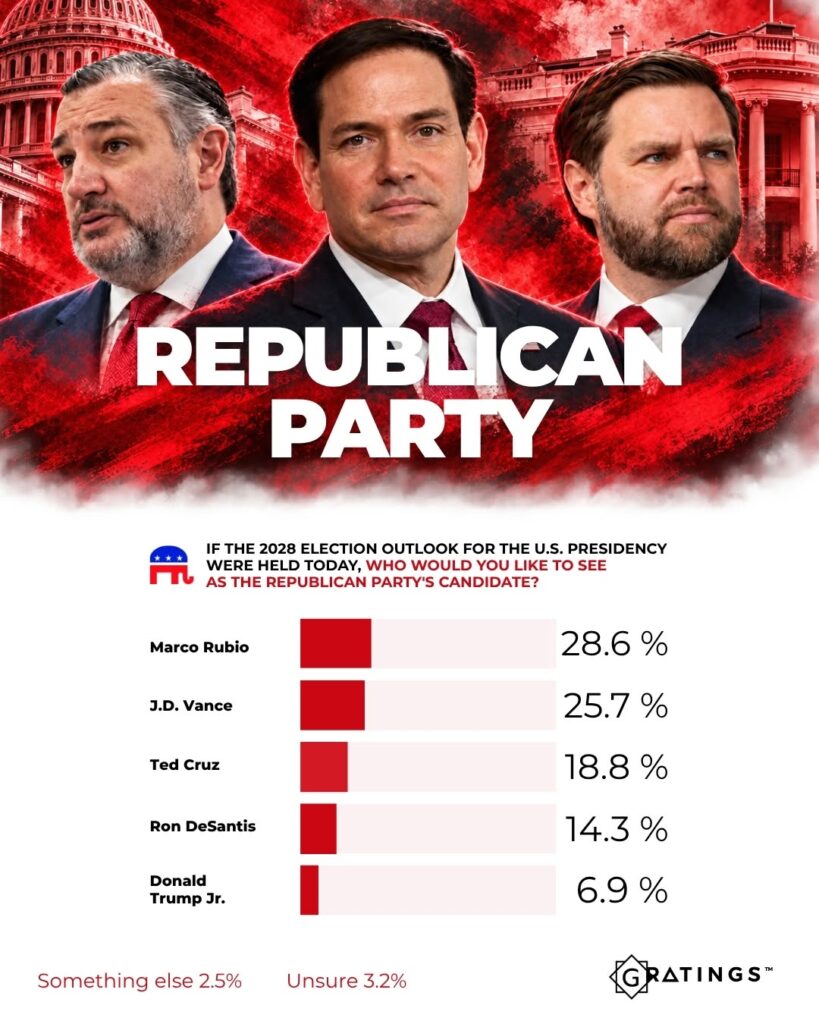
When Republican respondents were asked whom they would like to see as their party’s presidential candidate in 2028, Marco Rubio ranked first with 28.6%.
- Marco Rubio: 28.6%
- J.D. Vance: 25.7%
- Ted Cruz: 18.8%
- Ron DeSantis: 14.3%
- Donald Trump Jr.: 6.9%
- Unsure: 3.2%
- Something else: 2.5%
Rubio leads Vance by only 2.9 percentage points, indicating a competitive Republican contest without a dominant front-runner at this early stage.
Together, Rubio and Vance receive 54.3% of Republican preferences, meaning that more than half of the surveyed Republican electorate currently favors one of the two leading contenders.
Ted Cruz ranks third with 18.8%, placing him 6.9 points behind Vance. Ron DeSantis follows with 14.3%, while Donald Trump Jr. receives 6.9%.
Only 5.7% selected another option or remained unsure. This suggests that most Republican respondents already expressed a preference among the five potential candidates included in the survey.
Alexandria Ocasio-Cortez leads a divided Democratic field
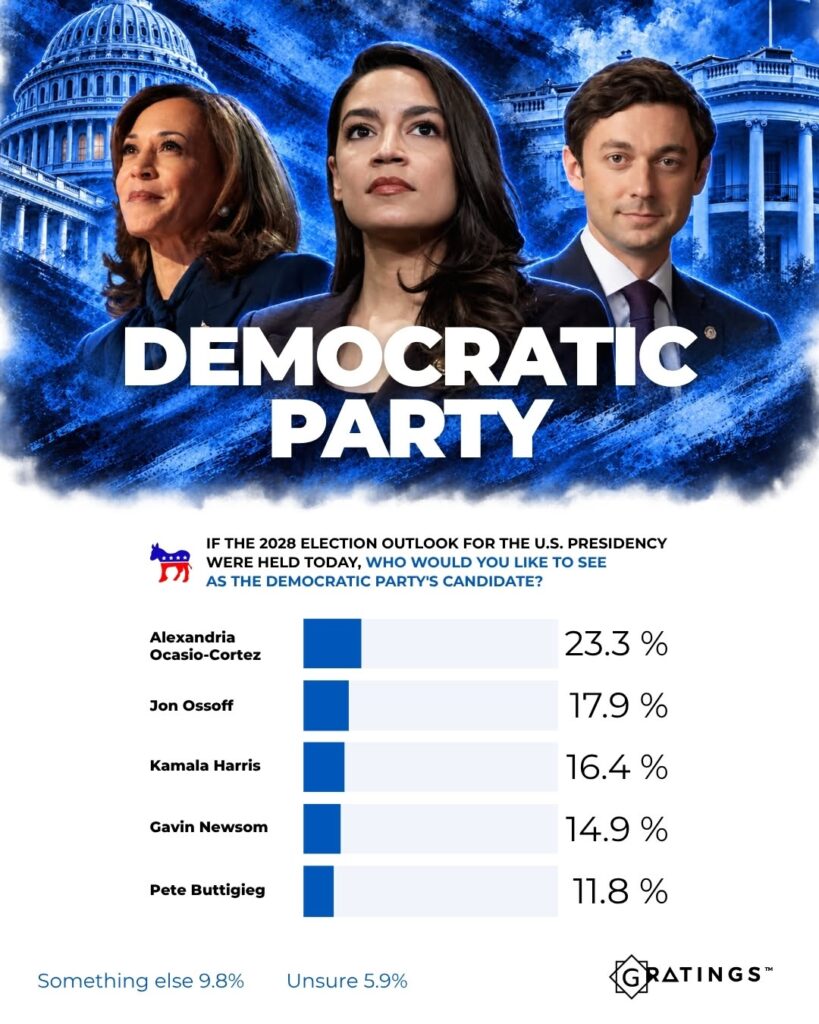
The Democratic contest is also competitive. Alexandria Ocasio-Cortez ranks first with 23.3%, but no candidate reaches one-quarter of the vote.
- Alexandria Ocasio-Cortez: 23.3%
- Jon Ossoff: 17.9%
- Kamala Harris: 16.4%
- Gavin Newsom: 14.9%
- Pete Buttigieg: 11.8%
- Something else: 9.8%
- Unsure: 5.9%
Ocasio-Cortez leads Jon Ossoff by 5.4 percentage points. Kamala Harris follows 1.5 points behind Ossoff, while Gavin Newsom remains close with 14.9%.
The gap between first-place Ocasio-Cortez and fourth-place Newsom is only 8.4 points, reflecting a Democratic field with support distributed among several possible candidates.
Pete Buttigieg receives 11.8%. Another 9.8% prefer someone outside the names presented, while 5.9% remain unsure.
The combined share for another candidate or undecided voters reaches 15.7%, leaving room for the Democratic race to change as new candidates, endorsements and campaign developments emerge.
The economy is the leading national concern
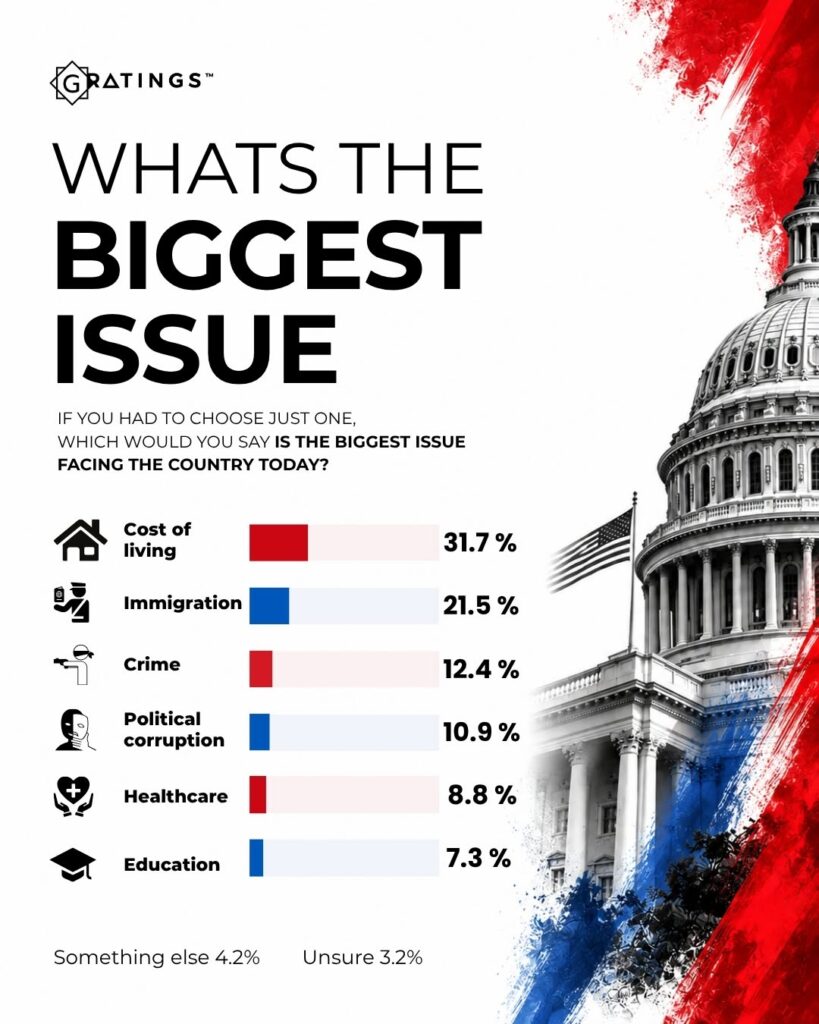
At G Ratings, we also surveyed voters about the single biggest issue facing the United States. The economy ranked first with 31.7%, ahead of immigration and crime.
- Economy: 31.7%
- Immigration: 21.5%
- Crime: 12.4%
- Corruption: 10.9%
- Healthcare: 8.8%
- Education: 7.3%
- Something else: 4.2%
- Unsure: 3.2%
Nearly one-third of respondents identify the economy as the country’s most important issue. It leads immigration by 10.2 percentage points.
When combined, the economy and immigration account for 53.2% of all responses, showing that these two issues dominate the concerns of the surveyed electorate.
Crime ranks third with 12.4%, followed by corruption at 10.9%. Healthcare and education receive lower percentages, although both remain important national concerns.
Only 4.2% selected another issue, while 3.2% were unsure.
Neither party has a dominant presidential front-runner
The October 2026 results show that both parties begin the 2028 presidential cycle with competitive fields.
Marco Rubio leads the Republican contest, but his advantage over J.D. Vance remains within three percentage points. Alexandria Ocasio-Cortez holds a wider lead among Democrats, although the vote is more fragmented across multiple candidates.
Unlike a race with one candidate far ahead of the field, these results reveal an early electoral environment in which several political figures remain competitive.
The preferences measured during this survey may change as the 2028 election approaches. Candidate announcements, campaign strategies, debates, endorsements and national events could influence voter decisions.
Methodology
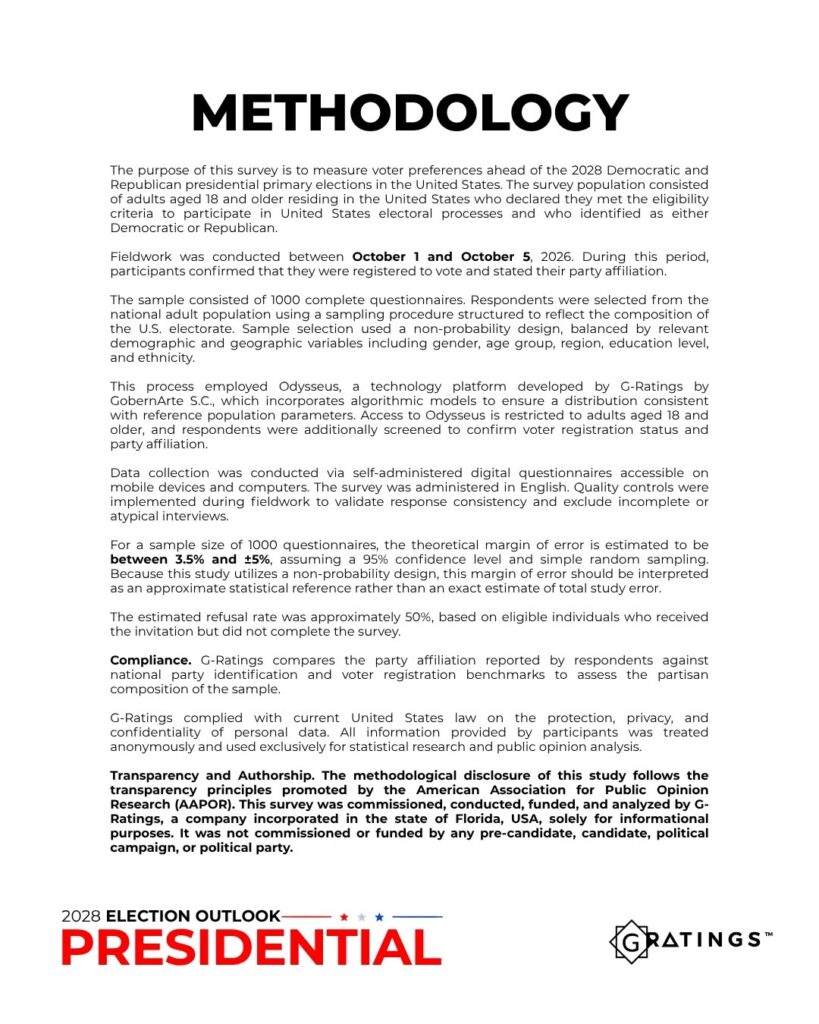
At G Ratings, we surveyed 1,000 adults aged 18 and older residing in the United States. Participants confirmed that they were registered voters, met the eligibility criteria to participate in U.S. elections and identified as either Democratic or Republican.
Fieldwork was conducted from October 1 through October 5, 2026. The survey was administered in English through self-administered digital questionnaires accessible on mobile devices and computers.
The sample was structured to reflect relevant characteristics of the U.S. electorate. It was balanced using demographic and geographic variables, including gender, age group, region, education level and ethnicity.
Data collection was conducted through Odysseus, a technology platform developed by G Ratings by GobernArte S.C. The platform incorporates algorithmic models designed to maintain a distribution consistent with reference population parameters.
Quality controls were applied during fieldwork to validate response consistency and exclude incomplete or atypical interviews.
For a sample of 1,000 completed questionnaires, the theoretical margin of error is estimated between ±3.5% and ±5%, with a 95% confidence level under a simple random sampling assumption.
Because the study used a non-probability design, this range should be interpreted as an approximate statistical reference rather than an exact estimate of total survey error.
The estimated refusal rate was approximately 50%, based on eligible individuals who received an invitation but did not complete the survey.
G Ratings compared the party affiliation reported by respondents with national party identification and voter registration benchmarks to assess the partisan composition of the sample.
The survey was commissioned, conducted, funded and analyzed by G Ratings, a company incorporated in Florida, exclusively for informational and public opinion research purposes. It was not commissioned or funded by any potential candidate, candidate, political campaign or political party.