
Results
At G Ratings, we conducted a statewide survey to measure voter preferences and the political climate ahead of the 2026 Illinois governor election. The results show Governor JB Pritzker leading with 51.3% of voter preference.
We surveyed 850 registered voters in Illinois who indicated that they intended to participate in the upcoming election. Fieldwork was conducted between August 28 and September 1, 2026.
At G Ratings, we present a race in which Pritzker currently holds a significant advantage over Republican Darren Bailey. However, 13.8% of respondents remain undecided or support another option, a segment that could still influence the electoral landscape as November approaches.
Illinois 2026 governor election: Pritzker leads Bailey
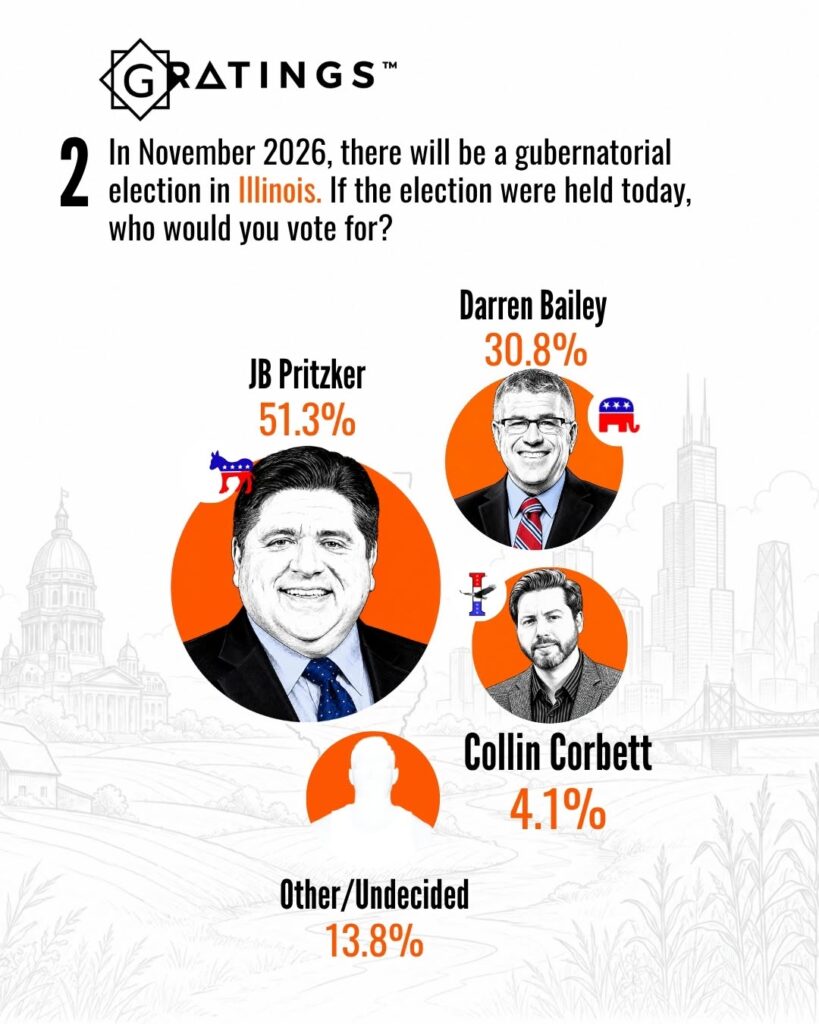
At G Ratings, we present the results of the question: In November 2026, there will be a gubernatorial election in Illinois. If the election were held today, who would you vote for?
- JB Pritzker: 51.3%
- Darren Bailey: 30.8%
- Other/Undecided: 13.8%
- Collin Corbett: 4.1%
The results place JB Pritzker 20.5 percentage points ahead of Darren Bailey in the current measurement.
Pritzker also surpasses the 50% mark, while Bailey receives support from nearly one-third of respondents. Meanwhile, the combined Other/Undecided category represents more than one in every ten voters surveyed.
The size of this group will remain important to follow as voters receive more information about candidates, proposals and campaign priorities ahead of Election Day.
Political affiliation among Illinois voters surveyed
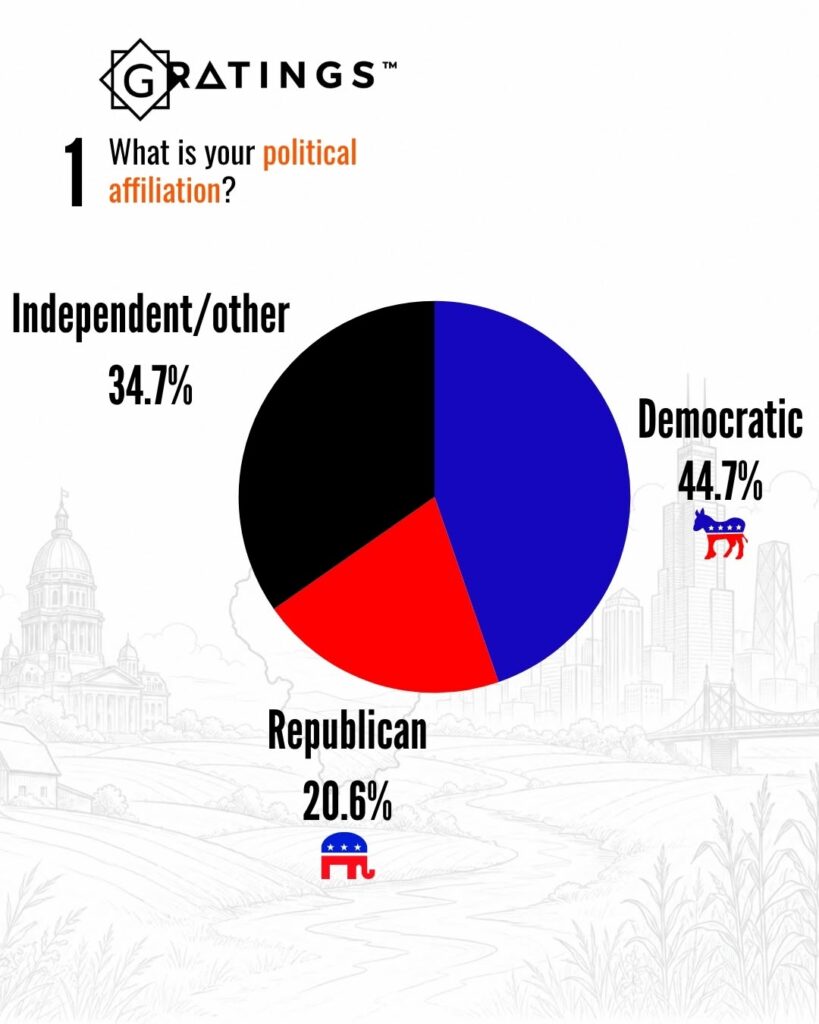
At G Ratings, we also surveyed participants about their political affiliation to better understand the political composition of the respondents.
- Democratic: 44.7%
- Independent/Other: 34.7%
- Republican: 20.6%
Democrats represent the largest political group in the survey, while more than one-third of respondents identify as independent or with another political affiliation.
Republicans account for 20.6% of those surveyed.
The size of the Independent/Other segment highlights the presence of voters outside the two major-party labels and provides additional context for understanding the preferences recorded in the gubernatorial contest.
Economy dominates voter concerns in Illinois
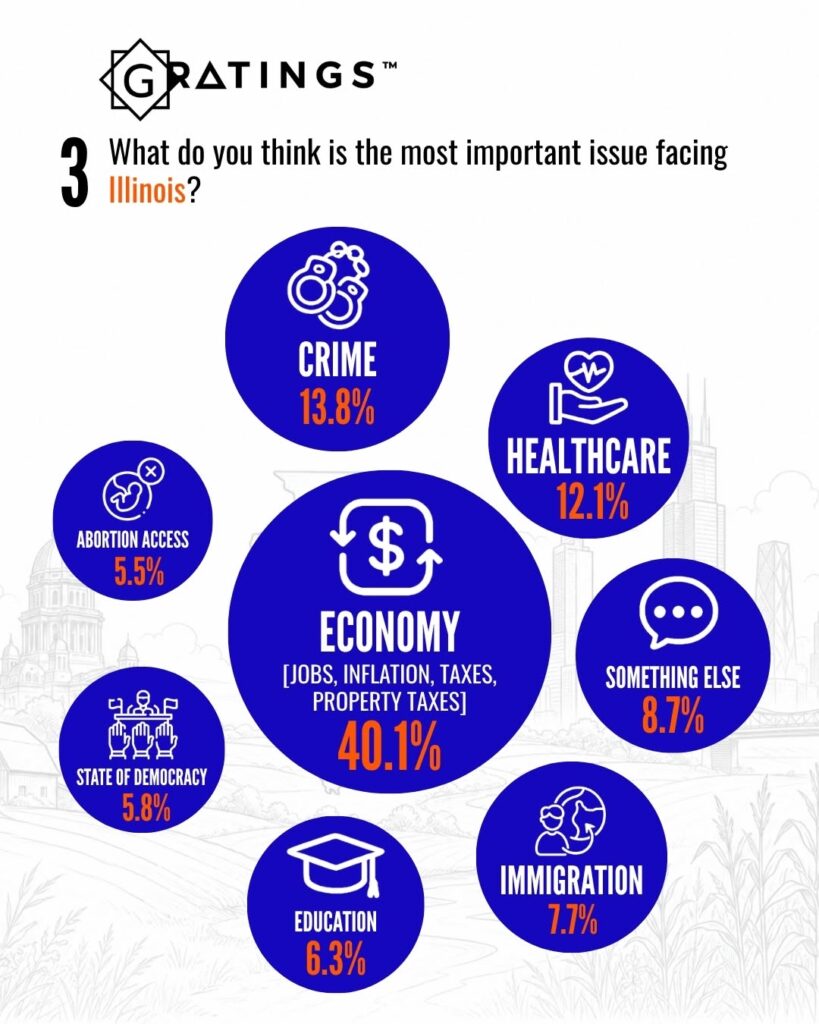
Beyond candidate preference, at G Ratings we surveyed Illinois voters about what they consider the most important issue currently facing the state.
The economy ranks first with 40.1%, making it the dominant concern among respondents. This category includes jobs, inflation, taxes and property taxes.
- Economy — jobs, inflation, taxes and property taxes: 40.1%
- Crime: 13.8%
- Healthcare: 12.1%
- Something else: 8.7%
- Immigration: 7.7%
- Education: 6.3%
- State of democracy: 5.8%
- Abortion access: 5.5%
The economy leads the second-ranked issue, crime, by 26.3 percentage points.
This result indicates that financial pressures, employment, inflation and taxation are central concerns for a substantial portion of Illinois voters as they consider their choices in the 2026 election.
Crime ranks second at 13.8%, while healthcare follows at 12.1%. Immigration, education, the state of democracy and abortion access also appear among the issues shaping voter concerns.
Economic issues could shape the Illinois governor race
The G Ratings survey presents an electoral environment in which economic concerns could play an important role in the 2026 campaign.
With 40.1% of respondents identifying the economy as the most important issue facing Illinois, candidates may face increased attention on their proposals related to jobs, inflation, taxes and property taxes.
At the same time, Pritzker’s 51.3% voter preference gives the Democratic candidate a clear advantage in this measurement.
Bailey stands at 30.8%, while Collin Corbett receives 4.1%. Another 13.8% remain undecided or support another option.
These figures provide a snapshot of voter sentiment at the time of the survey and allow G Ratings to track how electoral preferences may develop as the November election approaches.
Profile of the Illinois electorate surveyed
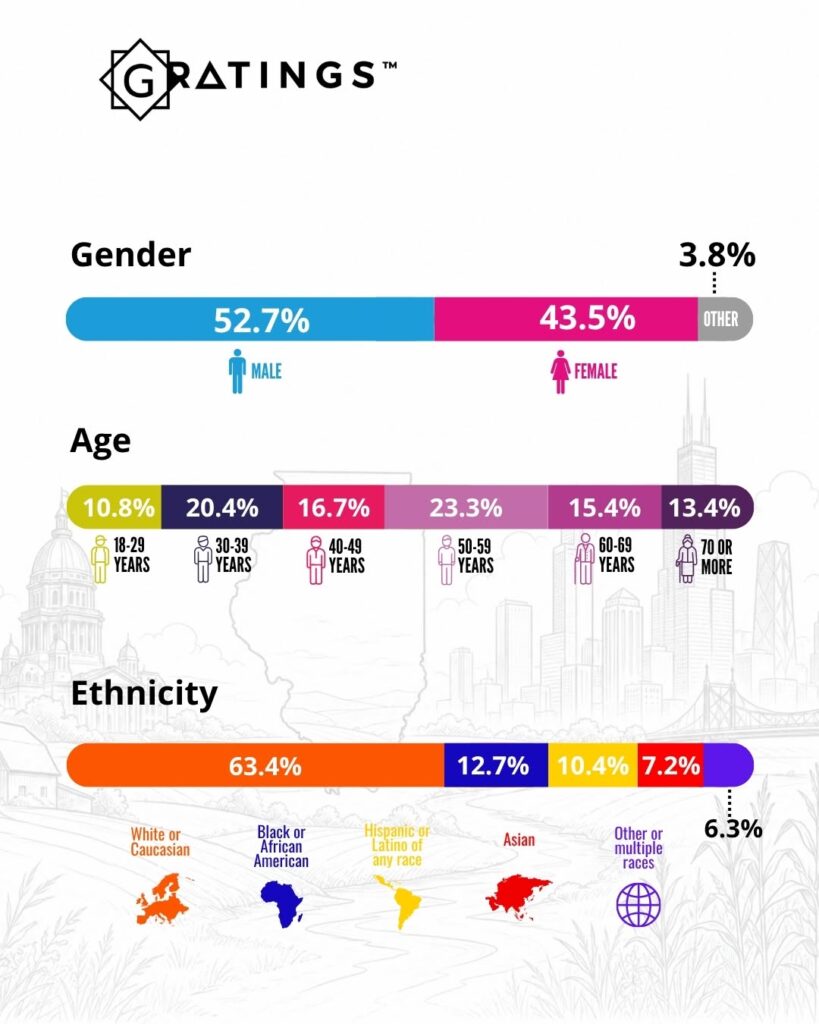
The survey included voters from different age groups, genders and ethnic backgrounds to reflect relevant characteristics of the Illinois electorate.
By gender, the sample consisted of:
- Male: 52.7%
- Female: 43.5%
- Other: 3.8%
By age group:
- Ages 18–29: 10.8%
- Ages 30–39: 20.4%
- Ages 40–49: 16.7%
- Ages 50–59: 23.3%
- Ages 60–69: 15.4%
- Ages 70 or older: 13.4%
The largest age segment was voters between 50 and 59 years old, representing 23.3% of respondents.
Survey methodology
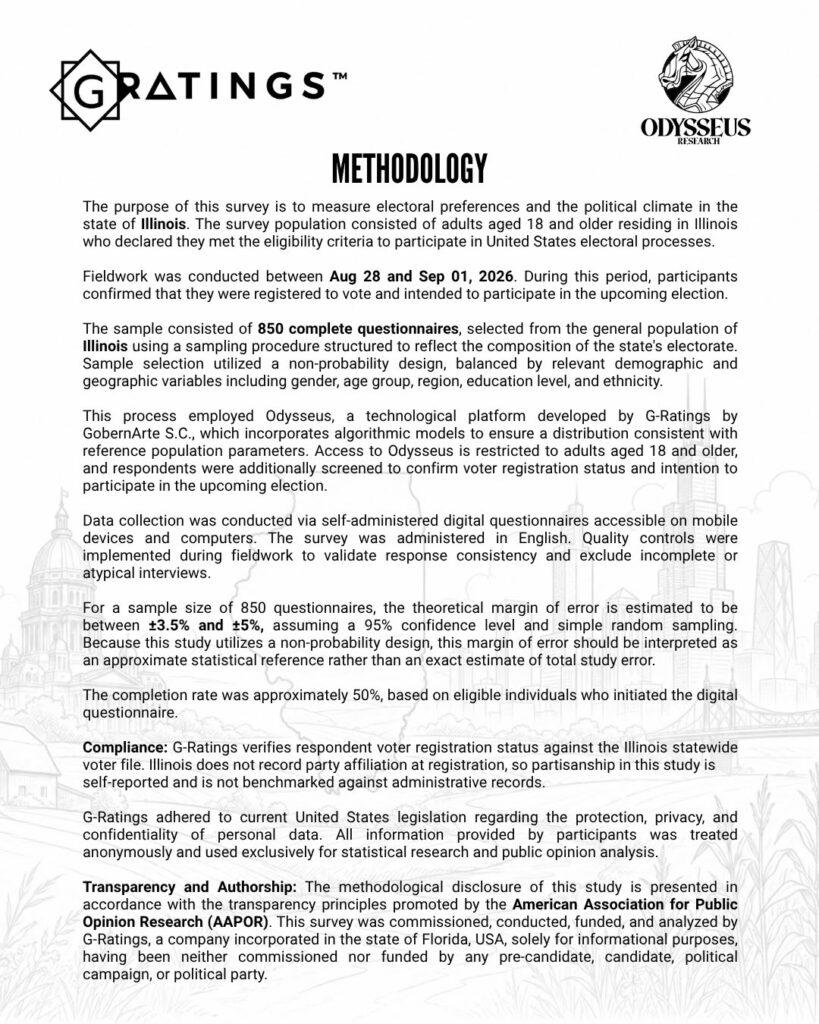
At G Ratings, we surveyed 850 adults aged 18 and older residing in Illinois who indicated that they met the eligibility requirements to participate in United States electoral processes.
Fieldwork was conducted between August 28 and September 1, 2026. Participants confirmed that they were registered to vote and intended to participate in the upcoming election.
The survey used a non-probability sample designed to reflect relevant demographic and geographic characteristics of the Illinois electorate, including gender, age group, region, education level and ethnicity.
Data collection was conducted through self-administered digital questionnaires accessible on mobile devices and computers. The survey was administered in English.
The study used Odysseus, a technological platform developed by G-Ratings by GobernArte S.C., incorporating algorithmic models designed to support sample distribution according to population reference parameters.
For the sample of 850 completed questionnaires, the theoretical margin of error was estimated between ±3.5% and ±5%, assuming a 95% confidence level and simple random sampling.
Because the study uses a non-probability design, this margin of error should be interpreted as an approximate statistical reference rather than an exact estimate of total survey error.
The completion rate was approximately 50% among eligible individuals who initiated the digital questionnaire.
The study was commissioned, conducted, funded and analyzed by G Ratings exclusively for informational purposes and was not commissioned or funded by any pre-candidate, candidate, political campaign or political party.